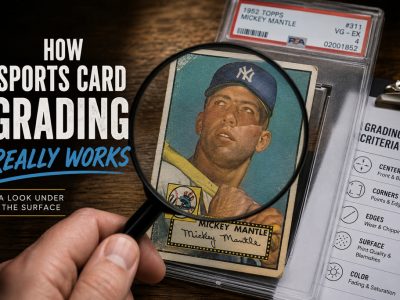

There’s no question that sports card grading is highly subjective. Numerical tiers published by the grading companies themselves tell us as much. Not only do grading point scales differ from company to company, but also the requirements for a perfect grade. Corners, centering, surface, and edges are the only real constants, with the equation varying according to each company’s guidelines.
Then there’s the human element. Arguably, the weakest link in the grading process. Ask three graders for their professional opinion, and you’ll likely receive three different answers. Part of the problem lies in consistency. How consistent can a human be after staring at hundreds of cards during an 8-hour shift? Are they still able to think as clearly at the end of the day as they were at the beginning?
Personal bias also plays a role. Conscious or unconscious shortcuts that lead to poor decision-making. We’ve all heard of the dreaded (GOD) grader of death. The running joke is that his girlfriend dumped him the night before he graded your cards. While that may be a possibility, it’s also likely that he has an overconfidence bias and doesn’t know the first thing about the cards you submitted.
Is Grading A Scam?
That is the million-dollar question. Grading in and of itself isn’t dishonest, and, technically, you do get what you pay for (assuming that you’re using a reputable company). Which, at the end of the day, is another person’s opinion. Whether that person is well-trained enough or is an actual expert in their field is where the lines begin to blur. For the most part, when you send cards in for grading, you have no idea who is grading them. Or what their level of expertise is.
You’re relying on the training the grading company is giving the grader, which is supposed to be based on the company’s grading standards. Are you beginning to see the problem? Any grading company can set any grading standard it wants. There is no true industry standard, outside of what the market dictates. So, you’re putting your faith (and money) into the idea that the grading company follows its own published standards and trains its graders to do the same. To the letter, without deviation or human bias.
Is Consistency Possible?
With so many variables in place, is consistent card grading even possible? Mathematically speaking, the odds of getting the same grade, on the same card, from different grading companies are slim. I did my own experiments with this several years ago, and found that the grades varied from 1-3 points across the board. While some of that may be due to different companies having different standards, there was also clearly a difference of opinion between the graders who reviewed my cards.
Tyler, AKA Tpott from the Market Movers YouTube channel set out to do his own grading experiment. Sending the same cards to five different grading companies to get their opinions. The results were surprising and in some cases, shocking. You’re left wondering if some of the graders are just making it up as they go. The experiment highlights a core truth about the hobby: grading is not an exact science, and understanding that can dramatically change how you collect, buy, and invest.
Key Points From The Video:
• Grading is highly inconsistent.
The biggest takeaway from the experiment is that grading outcomes can vary significantly. Even when nothing about the card changes.
• Human subjectivity plays a huge role.
One of the main reasons for inconsistency in card grading is human subjectivity and bias.
• Tech-Based Grading Isn’t Perfect Either.
Some companies use technology-assisted grading systems, which aim to reduce human error, but can cause other issues.
• Resubmitting cards is risky.
One of the most fascinating aspects of the experiment is how grades can change upon resubmission.
• Risk VS reward in grading.
Gradign is a risk-based decision. This is an important concept every collector should understand.
Watch The Full Video Here:
What Are You Actually Paying For?
The biggest takeaway from the experiment is that grading outcomes can vary significantly even when nothing about the card changes. The grade assigned to your card is an opinion, not a fact. The old adage, buy the card, not the grade still rings true today. Even experienced collectors sometimes forget this, especially when buying or selling based solely on the numerical value on the slab.
Know what you are paying for. You are paying for an opinion.” -Tyler Nethercott (AKA. Tpott)
One of the biggest misconceptions in the sports card hobby is the belief that a grading score is an objective, scientific measurement. In reality, a grade is best understood as a professional opinion based on a set of guidelines, not a fixed or absolute truth. At the end of the day, you’re paying for a supposed expert’s opinion, along with a plastic slab and a branded label. Grading does have a value. It provides authentication, standardization, and market confidence. But it’s not infallible.
Grading Alternatives?
If you’re a collector with a keen eye, you may trust your own instincts when it comes to your personal collection. If grading isn’t right for you, because of its subjective nature or cost, you can still build and display an incredible collection. Being able to safely display or show your cards is an important part of the hobby. Many collectors prefer to penny sleeve their cards and keep them in top loaders. Others keep their hits safe in a magnetic one-touch case, with a color-matched slab-mag. If you want the visual of a graded card, with your own custom label, there are options for that as well. It’s your hobby, enjoy it your way, responsibly.
Find Out More: Is Grading A Scam?
Subscribe to our Collector Newsletter below, and follow us on Instagram at this link.