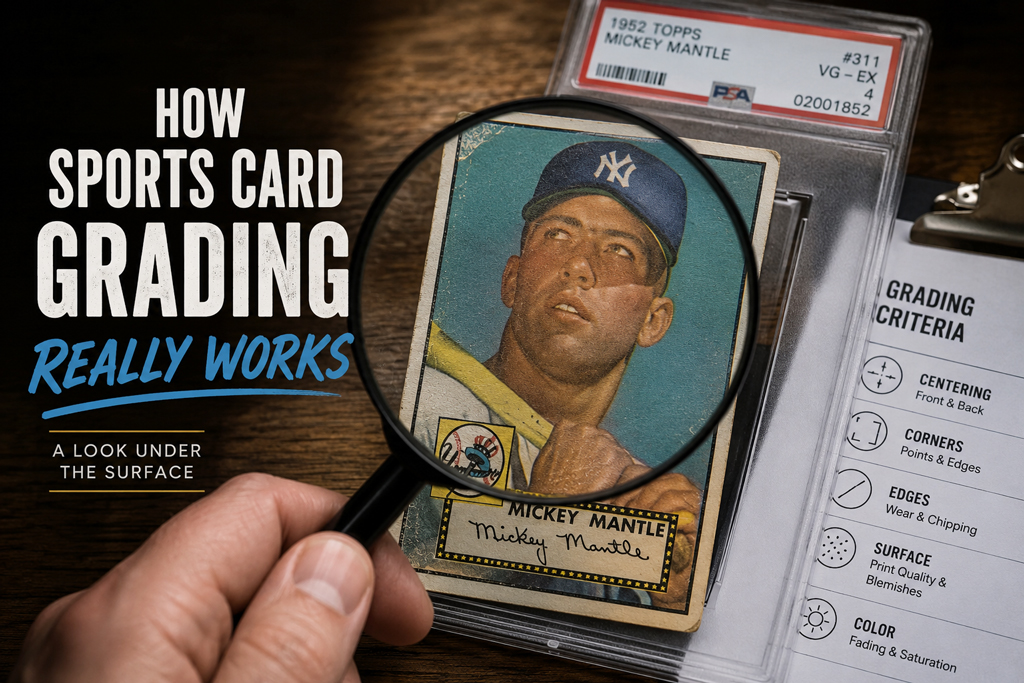
Boston Card Hunter is at it again, this week interviewing Dr. Ray Webb on his YouTube Channel. The former Director of Education at CGC & PSA offers an inside look at how card grading works. Lifting the curtain behind the scenes, shedding light on the standards, judgment calls, and operational realities that shape the final grade collectors see on a slab. Rather than treating grading as a simple checklist, the discussion suggests that the process involves a mix of technical evaluation, human interpretation, and business-scale workflow.
How Grading Really Works?
For collectors, the video is compelling because it pulls back the curtain on one of the hobby’s biggest questions: what actually happens between submission and final grade. The main value of the conversation is not just in exposing flaws or defending the system, but in helping viewers better understand why grading outcomes can feel inconsistent, subjective, or difficult to predict.
Key Points From The Interview
- Grading is more nuanced than most collectors assume.
The video appears to frame grading as a process shaped by both standards and judgment, not a purely mechanical pass/fail system. - Human subjectivity is likely a major theme.
With a former executive speaking openly, the video likely emphasizes that graders are making judgment calls, especially on borderline cards. - Consistency is one of the hobby’s biggest tension points.
A title like “how grading really works” suggests the discussion is aimed at explaining why the same card can sometimes receive different outcomes across submissions or grading companies. - Scale and workflow matter.
One probable takeaway is that grading is not just about card condition, but also about how a large operation handles volume, training, quality control, and internal standards. - Collectors should adjust expectations.
The practical lesson for viewers is likely that grading should be approached as an informed risk, not an exact science.
Training & Consistency
An interesting section from the interview deals with training and consistency. Dr. Ray Webb reveals that new graders struggle the most with identifying surface defects. This is partly because card surfaces appear differently in different lighting. Placing a card under a high output LED light, may reveal more surface defects than looking at the same card in the natural lighting of a room. Dr. Ray also pointed out how a card is tilted in the lighting used for grading plays a role in revealing surface flaws.
I can train anyone to grade centering to mastery in a few hours. Edges and corners are generally mastered in one day. Surface training takes days.” – Dr. Ray Webb
Grading Products Mentioned In The Video
During the interview, Dr. Ray Webb mentions using a 10X LED magnifying loupe, a high-resolution ruler, and microfiber cloths. These items are used by professional graders to inspect incoming cards. To ensure that the cards are clean before the final grading assessment. The ruler he mentions is the Lithco Ultra High Resolution Transparent Ruler. Essentially, it’s a flexible graphing ruler for exact measuring in printing, flexo, wide format, and a variety of industrial tasks.
For hand-held card inspection, he mentions using a Peak OPT-LSL10LUSB with #14 reticle. This 10X LED magnifying loupe is USB rechargeable and features a neutral white and 30mm field of view. Dr. Webb also mentions wiping off fingerprints and possible surface debris with a microfiber cloth, although he does not specify which style in the video.
The products mentioned in the interview are obviously professional-grade tools. Which means they come with professional-grade prices. If you’re on a budget and want tools that can provide similar results, here are a few options I pulled together below:
10x Loupe Magnifier Rechargeable Jewelers Loupe with UV & LED Lights
This loupe magnifier is a great option. It features a 25mm field of view (slightly less than the Peak model), with 4 interchangeable reticles. The loupe has 4 bright white LED lights, and 4 UV lights to help you see if a card has been altered or colored in. It offers 10x high magnification adjustable focus lens with a coated optic to cut down on flare, ghosting, and unwanted reflections. It’s made from a high-impact ABS material, and recharges via a standard USB-C cable.
Link HereLegends Card Grading Centering Tool & Gauge
Graphing rulers are cool, but if you’re not an engineer, you may experience a learning curve with learning how to read one. I actually prefer using an acetate centering tool when it comes to measuring sports cards. The Legends card centering tool makes it easy to find out if your card is centered or not. The kit includes 3 essentials. A centering tool, a centering percentages guide, and a handy card thickness gauge tool. which I’ve been using this same kit for years to check my cards before sending them off for grading.
Link HereMagicFiber Microfiber Cleaning Cloth
These microfiber cleaning cloths from MagicFiber are great for prepping your cards for grading. Chromium cards often come out of the packs with residue on the surface and small debris. Microfiber cleaning cloths are great for gently buffing the surface of cards. You can use them to remove residue, fingerprints, and small debris left from the card sheets being cut. Don’t send your cards in dirty. Make sure they are prepped and ready to be graded by the company of your choice.
Link HereWatch The Full Video Here:
Find Out More: How Grading Really Works?
Subscribe to our Collector Newsletter below, and follow us on Instagram at this link.